Skip to content
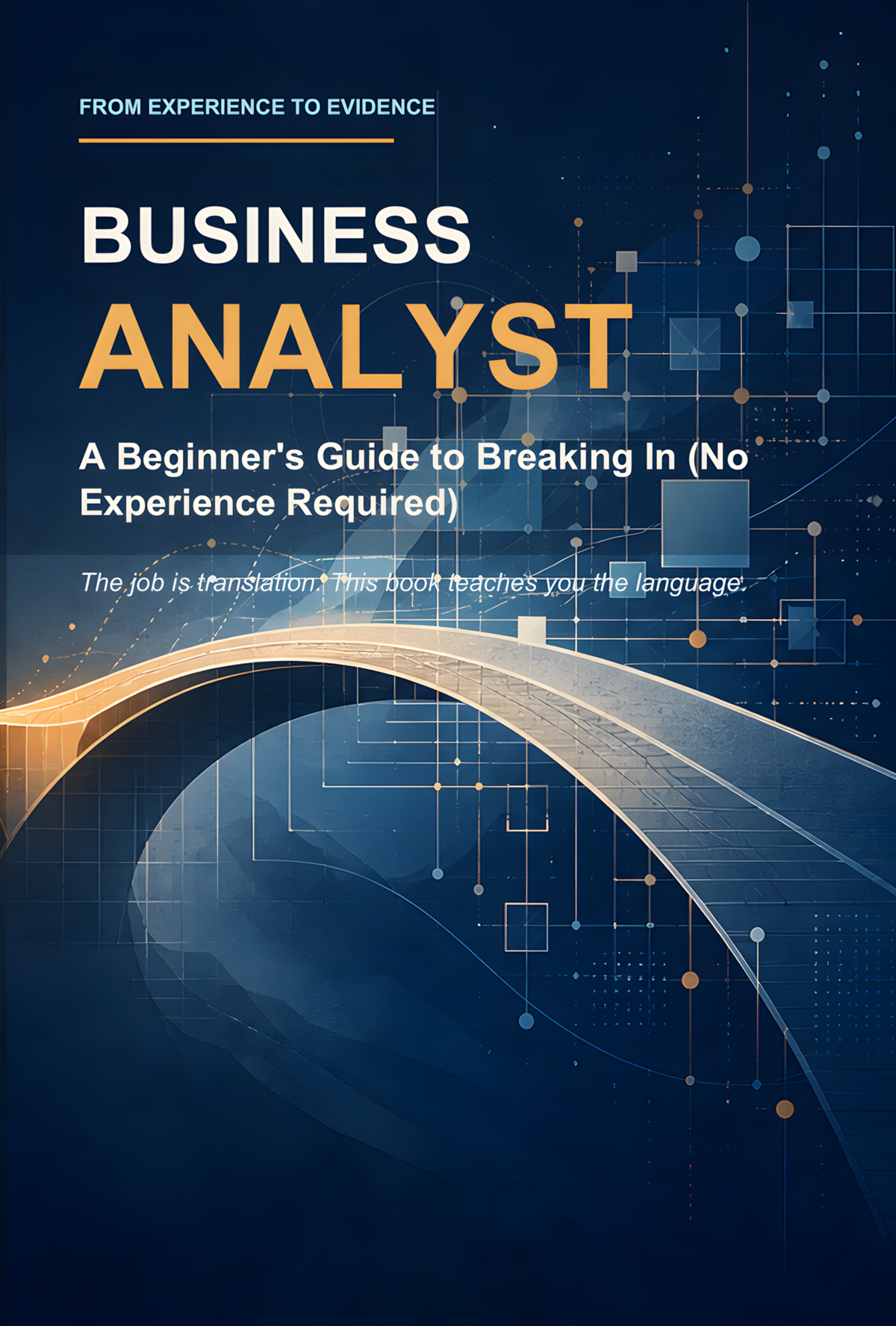
Business Analyst: A Beginner's Guide to Breaking In (No Experience Required)

Book 1 of 3 in the Business Analyst series

Start from zero and apply as a business analyst

Written for someone with no business background and no technical background. You learn the one idea the job rests on — a business analyst translates between what a business needs and what a technical team can build — then work it through Jira, a real user story, a rehearsed interview answer, and a thirty-day plan.

  • Instant download
  • EPUB + PDF
  • 30-day refund policy

Sound familiar?

01

A job posting you can't read

SQL, stakeholder management, Jira, something called BABOK, Agile ceremonies. You cannot tell which of those you would actually need.

02

Two smart people, still stuck

A bakery owner wants online ordering. A developer asks about payment capture and role-based access. Both are cooperating, and nothing moves.

03

The two questions that stall you

Do you need a certification before anyone takes you seriously? Is AI about to make this whole role unnecessary anyway?

What changes when you finish

  • Explain what a business analyst does day to day using the four-function framework: Decode, Optimize, Document, Communicate.
  • Read a Jira ticket and know what a story, an epic, and story points actually mean.
  • Write a real user story with acceptance criteria specific enough for a developer to build from.
  • Describe what AI is already automating in this role, and why the bridging, judgment-driven core of the job is not going away.
  • Rehearse a real behavioral interview answer using the STAR framework, built from a worked healthcare scenario.
  • Follow a concrete 30-day plan for turning what you've learned into an actual job application.
Eleven diagrams, an hour-by-hour Tuesday in the job, a full STAR interview answer built step by step, and a thirty-day application plan.

From the figures

The four core functions every BA performs — Decode, Optimize, Document, Communicate — each feeding the next.
  • An hour-by-hour look at one business analyst's Tuesday, from the 9 a.m. stand-up to the 5:15 closing message.
  • The STAR framework for interview answers: Situation, Task, Action, and Result, walked through step by step.

Every chapter

11 chapters, one running example.

  1. Chapter 1: What Is a Business Analyst, Really?

  2. Chapter 2: The Four Core Functions: Decode, Optimize, Document, Communicate

  3. Chapter 3: A Day in the Life of a Business Analyst

  4. Chapter 4: Essential Skills Every Business Analyst Needs

  5. Chapter 5: Your BA Toolbox: Jira, User Stories, and Acceptance Criteria

  6. Chapter 6: Requirements Gathering and the BABOK Standard

  7. Chapter 7: Getting Certified: ECBA as Your Starting Point

  8. Chapter 8: How AI Is Changing the BA Role (and Why You're Not Obsolete)

  9. Chapter 9: Communication and Documentation: Earning Stakeholder Trust

  10. Chapter 10: Interview Prep: The STAR Framework and a Real Scenario

  11. Chapter 11: Landing Your First BA Role and What Comes Next

Read the opening of chapter 1

The opening of chapter 1, exactly as printed.

Chapter 1: What Is a Business Analyst, Really?

Picture this conversation. A bakery owner named Nadia wants an online ordering system for her shop. She sits down with a developer and says, "I just want customers to be able to order a cake for pickup, and I want to know when someone's paid so I don't start baking for free."

The developer nods and starts asking questions Nadia has never thought about. "Do you need real-time inventory sync? Should the payment be captured at checkout or authorized and captured on fulfillment? What's your refund policy for cancellations inside 24 hours? Do you want role-based access for your two part-time staff?"

Nadia has no idea what half of those words mean. She just wants to stop losing money on cakes nobody picks up. The developer, meanwhile, cannot build anything useful from "I just want it to work" — that sentence contains zero information about what "work" actually means in a system. Both people are smart, both are trying to cooperate, and they are still stuck, because they are speaking two different professional languages and neither one is equipped to translate for the other.

Keep reading

That gap is where a business analyst lives. Not writing the code. Not running the bakery. Standing in the middle, making sure what Nadia actually needs and what the developer actually builds are the same thing.

A business analyst — usually shortened to BA — is the person whose job is to translate. Specifically: a BA takes what a business needs, in the business's own words, and turns it into something a technical team can actually build. Then the BA does the reverse translation too: taking what's technically possible, or technically difficult, or technically going to take six extra weeks, and explaining that back to the business side in terms they can act on.

That's the whole job, at its core. Everything else you'll learn about business analysis — the tools, the certifications, the meeting formats, the acronyms — is built on top of that one function. If you remember nothing else from this book, remember this: a BA exists to make sure that what one side of a conversation means is what the other side of the conversation hears.

Notice what the definition does not say. It doesn't say a BA writes software. It doesn't say a BA runs the business. A BA typically isn't the one clicking "deploy" and isn't the one deciding the company's five-year strategy. The BA's actual product is understanding — a shared, accurate, written-down understanding that both the business side and the technical side can point to and say, "yes, that's what we agreed on." That sounds modest. In practice it's one of the hardest and most valuable things anyone on a project does, because misunderstanding is the default state of any two people who don't share the same expertise, and understanding has to be actively built.

Before going further, it helps to clear out a few nearby job titles people confuse with this one, because the confusion isn't your fault — the roles genuinely overlap at the edges, and different companies draw the lines differently.

A business analyst is not a project manager. A project manager owns the schedule: who's doing what by when, whether the budget is on track, whether the team is blocked. A BA owns the meaning of the work itself: what's actually being built and why. A small team sometimes asks one person to do both jobs, which is part of why the titles blur in job postings, but the underlying skills are different. Managing a timeline and translating a requirement are not the same muscle.

A business analyst is not a developer, and doesn't need to know how to write production code to do the job well. A BA needs to understand technical constraints well enough to have an honest conversation about them — enough to know that "just add a login button" might mean building an entire authentication system — but the BA's job is to represent that constraint accurately to the business side, not to personally solve it in code.

A business analyst is also not just a note-taker or a report-writer, even though documentation is a real and necessary part of the job, which you'll see in the next chapter. Writing things down is how a BA makes the shared understanding durable — so it survives the meeting, survives someone forgetting a verbal agreement, survives a new team member joining eight months in and needing to know what was decided and why. But the thinking that goes into deciding what to write, which questions to ask first, and which stated request is hiding a different real need — that's the actual skill. The document is the output. The translation is the job.

You'll hear business analysts described as "a bridge between business and technology" so often in this field that it can start to sound like a throwaway phrase. It isn't, and it's worth sitting with the actual mechanics of what a bridge does, because the mechanics map onto a huge share of real BA work almost perfectly. It's worth being precise about what this framing is and isn't: the profession's own official definition is broader than software delivery — IIBA defines business analysis as enabling change by identifying organizational needs and recommending solutions that deliver value, not necessarily anything involving a technical build at all. Plenty of real BA work is pure process, strategy, or organizational-design work with no "technical side" in the picture. This book focuses specifically on the software-and-technology-delivery flavor of the role, because it's the most common entry point and the one this book's examples, tools, and interview prep are built around — not because it's the only shape the job takes.

Choose how you want it

This book

Business Analyst: A Beginner's Guide to Breaking In (No Experience Required)

This book
  • Instant download
  • EPUB + PDF
  • 30-day refund policy
Best value

The better deal for most readers

The Complete Business Analyst Series

3 ebooks + 3 audiobooks

$59.99 $79.94

save $19.95

The next two books pick up where this one stops, and the complete set — three ebooks and three audiobooks — costs less than the six bought separately.

See what is inside

Going for interviews?

The Career Accelerator adds the 124-question interview bank, the 30-day workbook and the mock-interview prompts to the complete series.

Prices in USD. VAT or sales tax is added at checkout where it applies. Checkout opens on Payhip, which handles payment and delivery.

Audiobooks are narrated by a synthetic voice.

Three books, one career

Start wherever your experience puts you. The series reads as a ladder, and the complete series costs less than the three books and three audiobooks bought separately.

  1. Business Analyst: A Beginner's Guide to Breaking In (No Experience Required)

    Book 1You are here

    No experience yet

    A Beginner's Guide to Breaking In (No Experience Required)

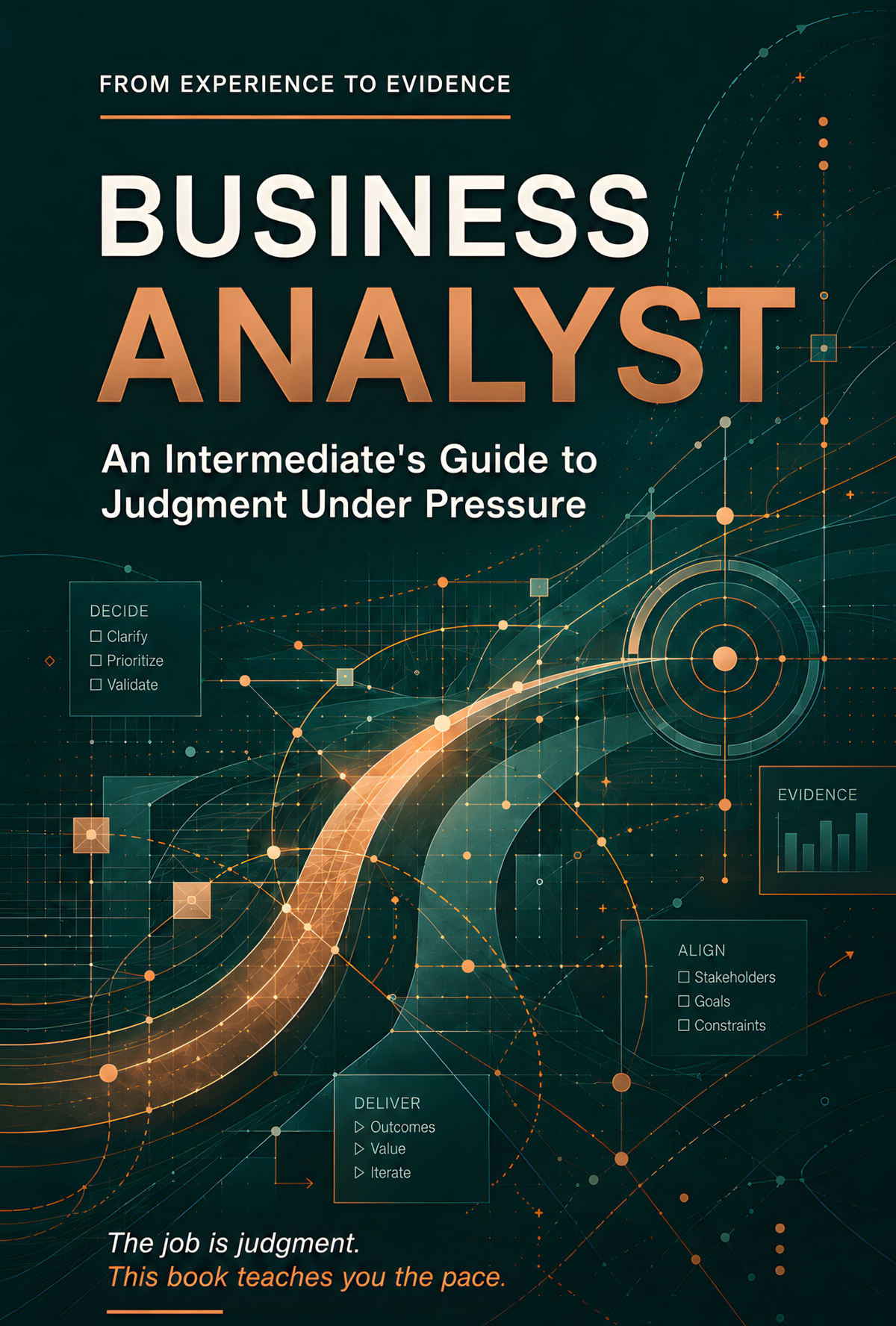
  2. Business Analyst: An Intermediate's Guide to Judgment Under Pressure

    Book 2

    One to four years in

    An Intermediate's Guide to Judgment Under Pressure

  3. Business Analyst: An Expert's Guide to Defending the Judgment Calls Evidence Alone Can't Make

    Book 3

    Senior, and the calls are yours

    An Expert's Guide to Defending the Judgment Calls Evidence Alone Can't Make

Questions before you buy

Which formats do I get when I buy here?

The ebook purchase includes the EPUB for any reader app and the print-layout PDF. The audiobook is an MP3 you download and keep.

Will it work on my Kindle, phone or tablet?

Yes. The EPUB opens in Apple Books, Google Play Books, Kobo and every reader app; Kindle devices accept it through Amazon's Send to Kindle. The PDF opens anywhere.

Is the PDF really included?

Yes. Every ebook bought from this site comes with the PDF at no extra cost.

What is the refund policy?

One 30-day refund policy covers everything bought on this site: books, audiobooks, book bundles, exam practice bundles and the Career Accelerators. Reply to your receipt within 30 days of purchase and the payment comes back, no questions. The refunds page has the details.

Which languages are available?

The three books exist as ebooks in English, Spanish, French, German, Portuguese and Arabic. The audiobooks and the bundles are in English.

Who narrates the audiobook?

A synthetic voice, and the recording follows the printed text word for word, so you can move between reading and listening without losing your place. The audiobooks are in English only.

How is the book delivered?

Immediately, and the files are yours to keep. The download page opens the moment payment completes, and the same link arrives by email with your receipt. If nothing has arrived within ten minutes, check the spam folder, then reply to the receipt and it is sent again.

Read chapter one tonight

EPUB and print-layout PDF the moment you buy, the audiobook sample playing on this page, and 30 days to ask for a refund.

Checkout

Business Analyst: A Beginner's Guide to Breaking In (No Experience Required)

One checkout, instant download

This book
  • Instant download
  • EPUB + PDF
  • 30-day refund policy

Best value

The Complete Business Analyst Series

3 ebooks + 3 audiobooks

See what is inside

Checkout opens on Payhip, which handles payment and delivery.

Digital products are delivered the moment you pay. By completing checkout you ask for immediate delivery and give up the 14-day right of withdrawal that applies to consumers in the EU and UK; our refund policy still applies.