Skip to content
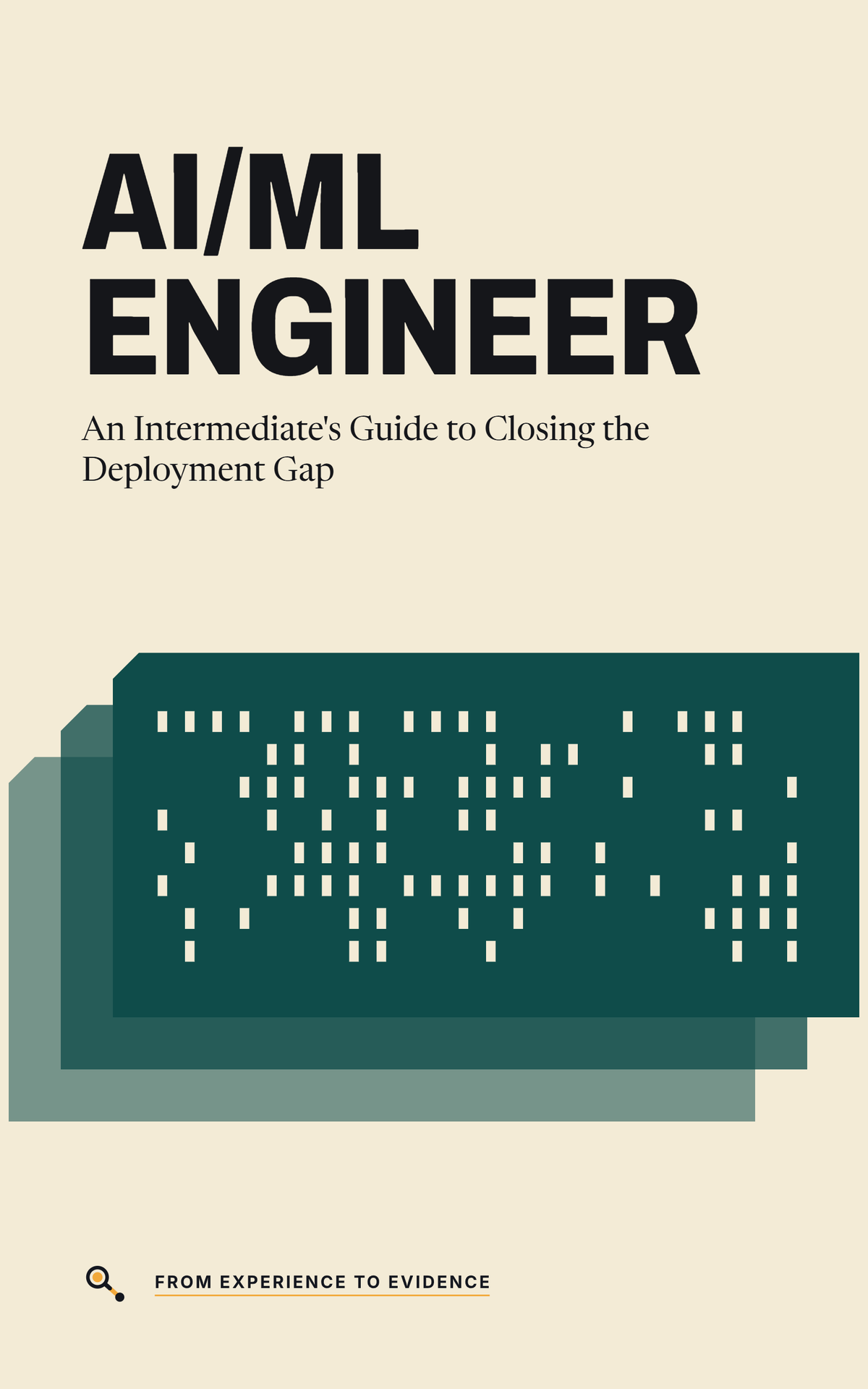
AI/ML Engineer: An Intermediate's Guide to Closing the Deployment Gap

Book 2 of 3 in the AI/ML Engineer series

Own the part of the job the title describes

Written for engineers who have trained a model and want to understand what happens after the code ships. You learn the production loop, the three ways live models fail, and the tools that catch them, worked through real incidents and real architecture decisions.

  • Instant download
  • EPUB + PDF
  • 30-day refund policy

Sound familiar?

01

Shipped clean, broke quietly

Validation looked fine and the canary rolled out fine. Four weeks in, something is wrong: the inputs, the outputs, or the model?

02

A feature pipeline gone unpredictable

A join works until the upstream table changes shape. A feature that always populated now returns nulls, and the model predicts on garbage.

03

Tools you cannot tell apart

The posting lists MLflow, Airflow, Kubernetes, Terraform, Argo and SageMaker. The docs give you marketing language, not the problem each one solves.

What changes when you finish

  • Explain the production ML loop — experimentation, deployment, monitoring, retraining — and the three distinct ways a live model actually breaks.
  • Read a production incident and diagnose whether the problem is input drift, prediction drift, or performance degradation.
  • Walk through a real feature pipeline, identify where schema changes and data quality issues hide, and name the SQL discipline that catches them.
  • Compare PyTorch and TensorFlow as a genuine tradeoff, and know where Docker, Kubernetes, MLflow, Airflow, and managed platforms each belong in a real system.
  • Build a production-ready RAG system and know the specific failure modes RAG and fine-tuning each address.
  • Work through a production-debugging scenario and an ML system design interview question with a framework that separates diagnosis from fix.
Nine chapters, four production incidents worked backward, the three drift types and the framework that catches them, a full system design interview.

From the figures

The Production ML Loop
  • Where the code in a mature ML system actually goes
  • The Production Debugging Framework

Every chapter

9 chapters, one running example.

  1. Chapter 1: The Production Loop: From Experiment to Retraining

  2. Chapter 2: Feature Engineering and the Pipeline Jungle

  3. Chapter 3: The Stack in Practice: Frameworks, Containers, and Infrastructure Tradeoffs

  4. Chapter 4: MLOps and LLMOps as an Engineering Discipline

  5. Chapter 5: The LLM Specialization Track: RAG, Fine-Tuning, and Vector Databases

  6. Chapter 6: Where AI Projects Actually Fail: The Deployment Gap

  7. Chapter 7: Career Progression and Reading a Noisy Market

  8. Chapter 8: Building a Portfolio That Actually Gets You Hired

  9. Chapter 9: Interview Prep: Production Debugging and System Design

Read the opening of chapter 1

The opening of chapter 1, exactly as printed.

Chapter 1: The Production Loop: From Experiment to Retraining

A model that scored 0.94 AUC in the notebook and got a round of applause in the Friday demo is not a finished piece of work. It's a hypothesis that hasn't met production traffic yet. You already know this in the abstract; it's the whole reason "ship it" feels different from "train it." What's less obvious until you've lived through a few release cycles is that the gap between those two moments isn't a single deployment step. It's a loop, and the loop doesn't stop once the model is live. It just changes what it's asking of you.

That loop, experimentation, deployment, monitoring, retraining, and back to experimentation, is the actual job. Not the modeling. The modeling is one stage out of four, and arguably the one that eats the least of your calendar once a system has been live for six months. Everything in this book comes back to this loop, and this chapter is where you get fluent in its vocabulary, especially the part most engineers learn the hard way: the three distinct ways a production model can go wrong, and why treating them as interchangeable is how a two-hour incident turns into a two-week one.

Experimentation is the part that looks like data science and mostly still is: feature iteration, architecture choices, hyperparameter sweeps. What separates it at engineering maturity is that none of it happens off the books. Every run gets logged to something like MLflow: the code version, the data snapshot, the hyperparameters, the resulting metrics, the artifact itself. This isn't bureaucracy for its own sake. Six weeks after a model ships, someone, often you, will need to answer "why did we pick this configuration over the other four we tried," and "I remember it being a bit better" is not an answer that survives a postmortem. The experiment tracker is also what makes a rollback more than a guess: you can pull the exact artifact and exact preprocessing that produced last quarter's known-good model instead of reconstructing it from memory and hoping the reconstruction matches.

Keep reading

The part of this that trips people up once they're past toy projects is that "same configuration" doesn't automatically mean "same result." A hyperparameter sweep logged faithfully to MLflow still has to contend with the data snapshot underneath it changing between runs if the pipeline pulls from a live table rather than a frozen extract, and with non-determinism in training itself, GPU-level floating point ordering, unpinned random seeds in a data-loading shuffle, a dependency that silently bumped a minor version between two runs. None of that shows up as an error. It shows up as a run that logs cleanly, looks reproducible on paper, and quietly isn't. The discipline that fixes this is boring and worth doing anyway: pin the data snapshot by hash or timestamped extract, not by "the current state of the table," fix the random seed and log it alongside everything else, and pin dependency versions in the environment the experiment actually ran in, not just the ones you meant to use. Skipping this doesn't cost you anything until the day you need to prove why last quarter's model behaved the way it did and discover the "reproducible" run doesn't reproduce.

Deployment takes whatever experimentation validated and turns it into something a service can call. The model gets packaged into a Docker container, dependencies pinned, runtime consistent regardless of which machine it lands on, and that container runs under Kubernetes, which handles the parts you don't want to hand-roll: restarting a crashed pod, scaling replicas under load, routing traffic to the version you actually intend to serve. The mechanics of containerizing a model aren't the hard part at this stage of your career; you've done it. What gets harder, and what's worth walking through in more detail than "gate it in stages" implies, is the actual sequencing of how a new version earns its way to full traffic.

It typically starts with a shadow deployment: the new model runs alongside the current production model on real, live requests, but its predictions never reach a user. They get logged and compared against the incumbent model's predictions and, once labels arrive, against ground truth. Shadow mode is where you catch the failures that never showed up in offline evaluation, because now the model is seeing the actual, messy, occasionally malformed input traffic instead of a curated test set. A model that shadow-deploys cleanly for a few days, with predictions in the expected range and no latency surprises, earns a canary: real traffic, but a small slice of it, often one to five percent, actually served by the new version. This is the first point where the new model's behavior has real consequences, which is exactly why the slice stays small. You watch the canary's live metrics against the same thresholds you'll eventually monitor in full production, not just accuracy but latency, error rate, and the shape of its output distribution, and you watch them separately from the other 95 to 99 percent of traffic so a regression in the canary doesn't get diluted into an average that looks fine. Only once the canary holds for a defined observation window, long enough to see a full daily or weekly traffic cycle rather than just a quiet afternoon, does the rollout widen: 5 percent to 25, 25 to 50, 50 to 100, each step gated the same way, each step reversible in minutes rather than hours if something degrades.
Choose how you want it

This book

AI/ML Engineer: An Intermediate's Guide to Closing the Deployment Gap

This book
  • Instant download
  • EPUB + PDF
  • 30-day refund policy
Best value

The better deal for most readers

The Complete AI/ML Engineer Series

3 ebooks + 3 audiobooks

$59.99 $79.94

save $19.95

The first and third books cover entry and mastery; the complete set of three ebooks and three audiobooks costs less than the six bought separately.

See what is inside

Going for interviews?

The Career Accelerator adds the 126-question interview bank, the 30-day workbook and the mock-interview prompts to the complete series.

Prices in USD. VAT or sales tax is added at checkout where it applies. Checkout opens on Payhip, which handles payment and delivery.

Audiobooks are narrated by a synthetic voice.

Three books, one career

Start wherever your experience puts you. The series reads as a ladder, and the complete series costs less than the three books and three audiobooks bought separately.

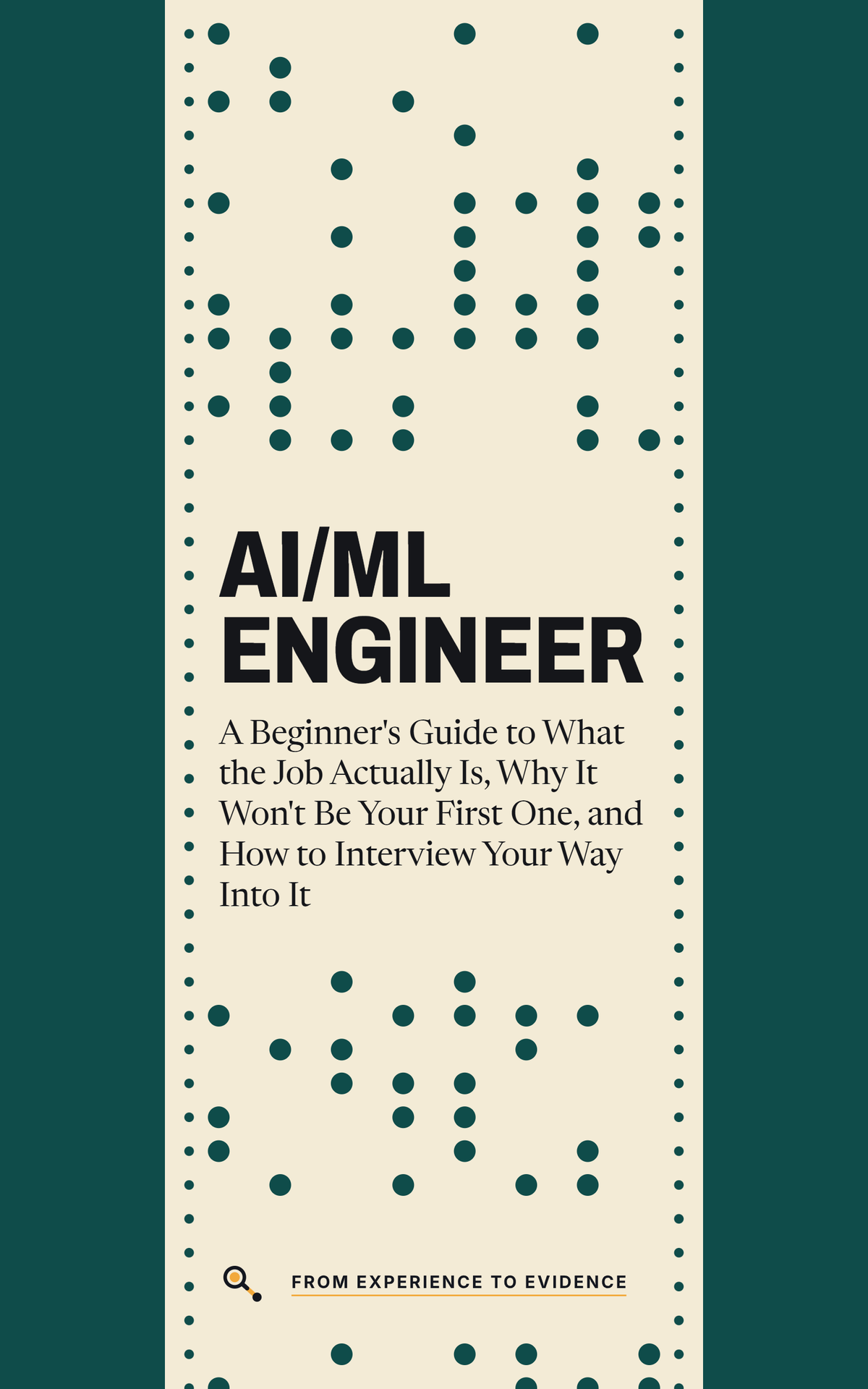
  1. AI/ML Engineer: A Beginner's Guide to What the Job Actually Is, Why It Won't Be Your First One, and How to Interview Your Way Into It

    Book 1

    No production ML experience yet

    A Beginner's Guide to What the Job Actually Is, Why It Won't Be Your First One, and How to Interview Your Way Into It

  2. AI/ML Engineer: An Intermediate's Guide to Closing the Deployment Gap

    Book 2You are here

    One to four years in

    An Intermediate's Guide to Closing the Deployment Gap

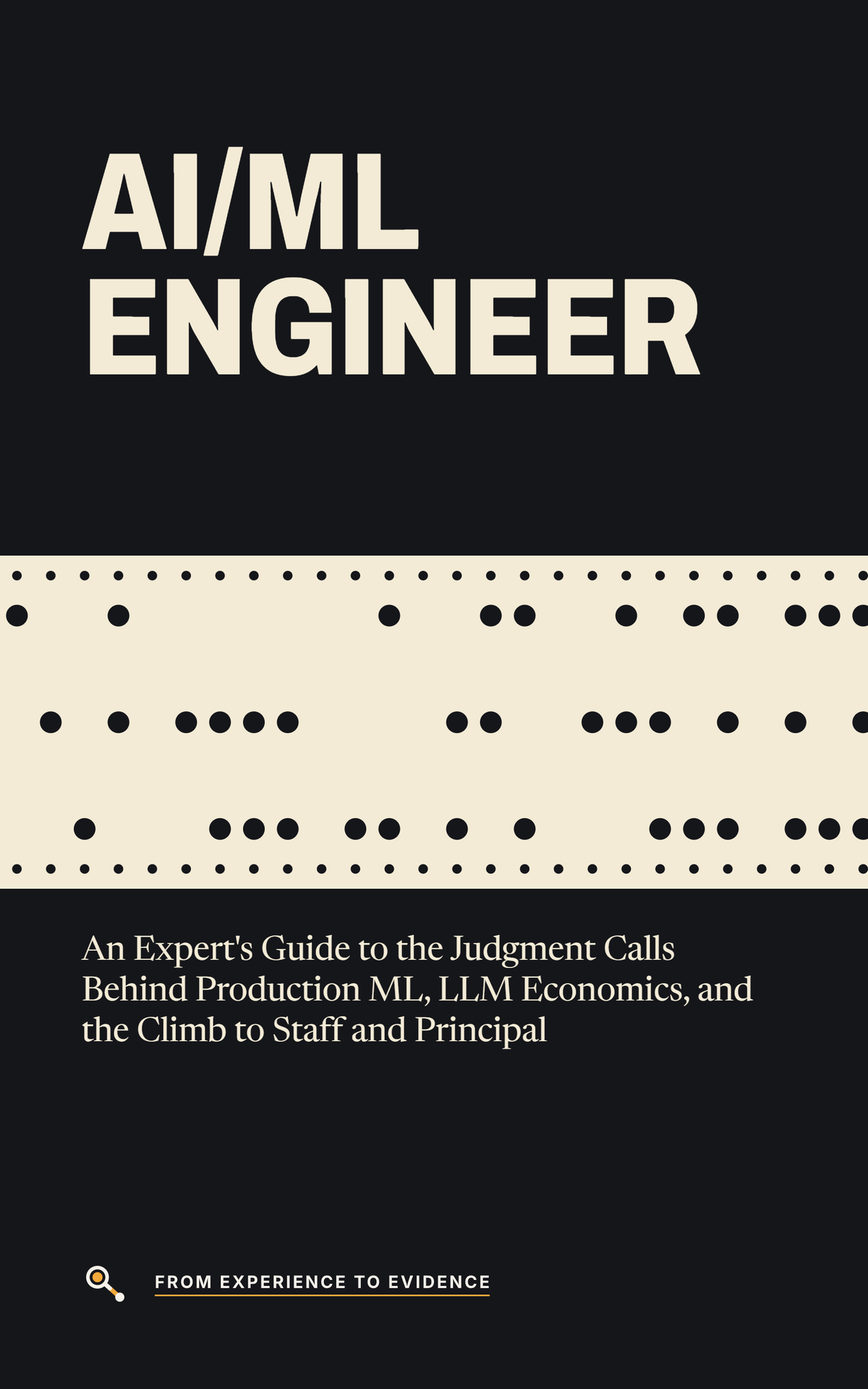
  3. AI/ML Engineer: An Expert's Guide to the Judgment Calls Behind Production ML, LLM Economics, and the Climb to Staff and Principal

    Book 3

    Senior, choosing technical depth or management path

    An Expert's Guide to the Judgment Calls Behind Production ML, LLM Economics, and the Climb to Staff and Principal

Questions before you buy

Which formats do I get when I buy here?

The ebook purchase includes the EPUB for any reader app and the print-layout PDF. The audiobook is an MP3 you download and keep.

Will it work on my Kindle, phone or tablet?

Yes. The EPUB opens in Apple Books, Google Play Books, Kobo and every reader app; Kindle devices accept it through Amazon's Send to Kindle. The PDF opens anywhere.

Is the PDF really included?

Yes. Every ebook bought from this site comes with the PDF at no extra cost.

What is the refund policy?

One 30-day refund policy covers everything bought on this site: books, audiobooks, book bundles, exam practice bundles and the Career Accelerators. Reply to your receipt within 30 days of purchase and the payment comes back, no questions. The refunds page has the details.

Which languages are available?

The three books exist as ebooks in English, Spanish, French, German, Portuguese and Arabic. The audiobooks and the bundles are in English.

Who narrates the audiobook?

A synthetic voice, and the recording follows the printed text word for word, so you can move between reading and listening without losing your place. The audiobooks are in English only.

How is the book delivered?

Immediately, and the files are yours to keep. The download page opens the moment payment completes, and the same link arrives by email with your receipt. If nothing has arrived within ten minutes, check the spam folder, then reply to the receipt and it is sent again.

Read chapter one tonight

EPUB and print-layout PDF the moment you buy, the audiobook sample playing on this page, and 30 days to ask for a refund.

Checkout

AI/ML Engineer: An Intermediate's Guide to Closing the Deployment Gap

One checkout, instant download

This book
  • Instant download
  • EPUB + PDF
  • 30-day refund policy

Best value

The Complete AI/ML Engineer Series

3 ebooks + 3 audiobooks

See what is inside

Checkout opens on Payhip, which handles payment and delivery.

Digital products are delivered the moment you pay. By completing checkout you ask for immediate delivery and give up the 14-day right of withdrawal that applies to consumers in the EU and UK; our refund policy still applies.