Skip to content
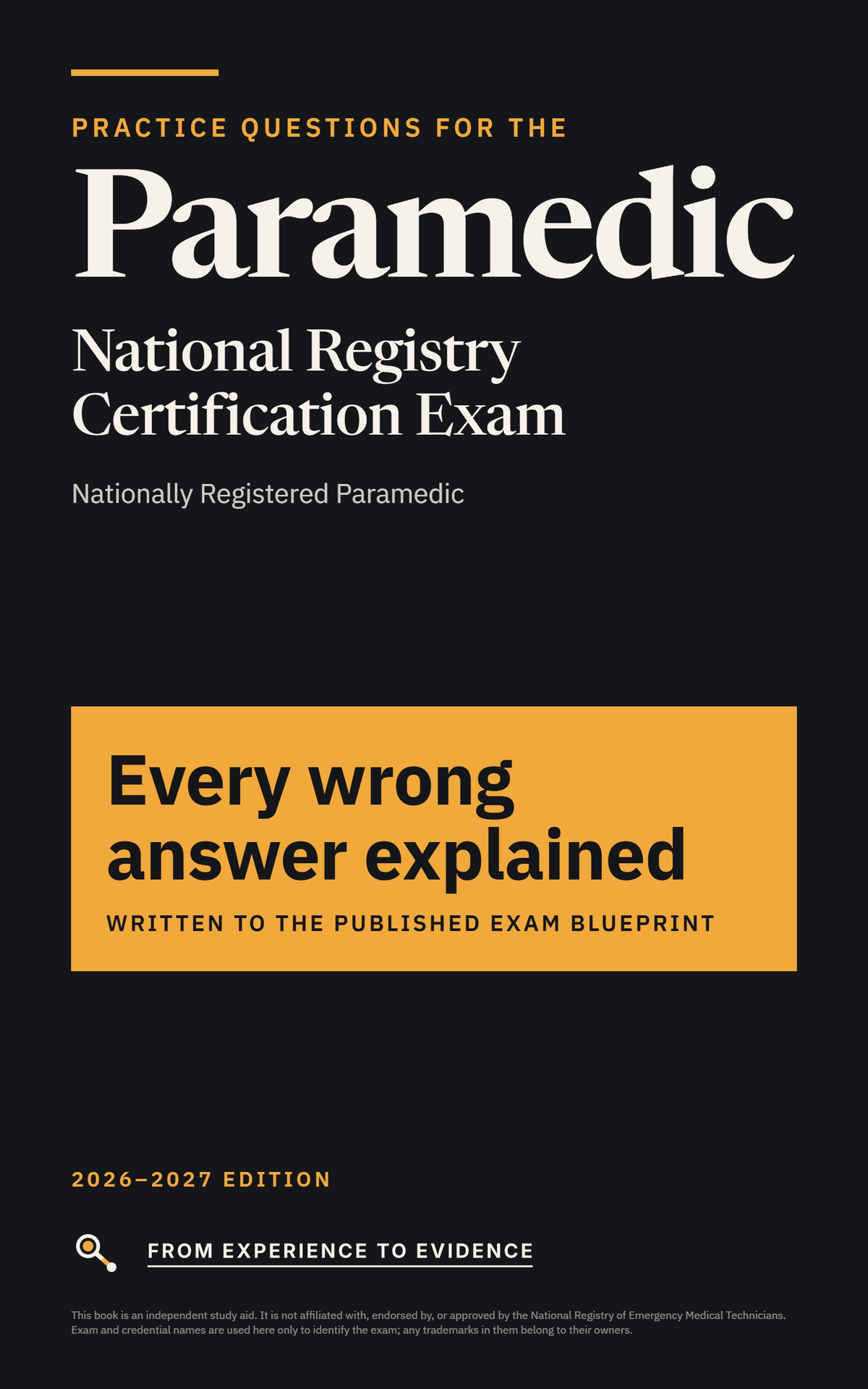
Practice Questions for the Paramedic National Registry Certification Exam: Nationally Registered Paramedic

For the Paramedic exam

Find out which answers are wrong, and why

Written for the stage of study where the reading is done. 341 questions drawn to the published National Registry test plan, and every explanation names the misconception behind each wrong option, the words in the question that rule it out, and the line that separates the key from the next-best answer.

  • Instant download
  • EPUB + PDF
  • 30-day refund policy

The exam this book is written to

Everything on this panel comes from the published document the questions were written from.

Certifying body
National Registry of Emergency Medical Technicians
Published document
NREMT Paramedic cognitive exam test plan
NREMT-Paramedic-Test-Plan-1July2024
Questions on the exam
150
210 minutes
Format
Computer-adaptive, 110 to 150 questions in up to 210 minutes, with multiple-response, build-list and drag-and-drop items as well as multiple choice.

What changes when you work it

  • Work a diagnostic that returns a study order weighted by the test plan rather than a score.
  • Recognize a second-best answer for what it is, before the exam asks you to choose one.
  • Decide what a paramedic does first in a scenario instead of reciting which protocol matches it.
  • Handle clinical judgment at the 34 percent weight the test plan gives it.
  • Sit two timed practice exams of 136 questions, mixed in the test plan's proportions.
  • Name the misconception behind every wrong option you pick, so the same error stops repeating.

How the book is organised

One chapter per area, in the published proportions. The diagnostic and both practice exams are drawn at the same weights.

Area of the examShare of the exam
Airway, Respiration & VentilationAssessing and securing the airway, oxygenation and ventilation, including advanced airways and ventilator support.10%
Cardiology & ResuscitationRhythm recognition, ECG interpretation, acute coronary syndromes and the management of cardiac arrest.12%
TraumaThe primary survey, head and spinal injury, hemorrhage control, burns and crush injury, and field triage to the right destination.8%
Medical/Obstetrics/GynecologyNeurologic, metabolic, allergic, behavioral, toxicologic and environmental emergencies, plus pregnancy, delivery and the newborn, across the age range.26%
EMS OperationsVehicles and equipment, scope of practice and leadership, documentation and handoff, consent and refusal, and hazardous or mass-casualty scenes.10%
Clinical JudgmentPutting the findings together to choose the next step, and the one that comes first. The largest area.34%

What is different about the explanations

Most prep books explain the correct answer and leave the other three alone. Every explanation here does four things, in this order.

01

Why the key is right

Traced back to the task statement in the published blueprint that the question was written from.

02

Why the wrong option was tempting

The misconception behind it, named. A wrong answer is built out of something, and that something has a name.

03

The detail that rules it out

The words in the question itself that make the option wrong, so the tell is one you can use again.

04

The key against the next best

One line separating the answer from the one most candidates take instead. On a scenario exam that gap is the whole exam.

Two questions from the book

Taken from the bank as they are printed, with the whole explanation.

Cardiology & Resuscitation · CAR-3

You are the paramedic in a ten-floor office building lobby, where a 55-year-old man has collapsed next to an elevator and is not breathing. Your team has started compressions. No advanced airway is in place yet, and bag-mask ventilation is being set up. Which compression-to-breath ratio should the team use now?

  1. A15 compressions to 2 breaths
  2. B1 breath every 6 seconds with continuous compressions
  3. C30 compressions to 1 breath
  4. D30 compressions to 2 breaths

The answer is D

Why it is right. In the AHA 2025 adult arrest algorithm, 30 compressions to 2 breaths is used when no advanced airway is in place. The 1-breath-every-6-seconds pattern starts only after an advanced airway is placed. The 15-to-2 ratio is a pediatric two-rescuer ratio and does not apply to this adult.

Why each of the others was tempting

  • AThe pediatric two-rescuer ratio applies to adults

    Would be right if: The patient were a child before puberty and two rescuers were working

    What rules it out: The patient is a 55-year-old adult.

  • BThe advanced-airway rhythm is used as soon as ventilation starts

    Would be right if: An advanced airway were already placed

    What rules it out: No advanced airway is in place yet.

  • COne breath per cycle saves time

    Would be right if: The algorithm called for one breath per cycle without an advanced airway

    What rules it out: No advanced airway is in place, so the standard cycle is 2 breaths.

The key against the next best. The key uses the adult ratio for an unprotected airway, while the strongest distractor applies the pediatric two-rescuer ratio to an adult.

Medical/Obstetrics/Gynecology · MOG-2

A 72-year-old man on anticoagulant medication for atrial fibrillation is found in the booking area of a county jail. He is agitated, his right arm and leg are weak, and he says he woke up with these symptoms this morning. Before committing him to the stroke pathway, which step must the paramedic take?

  1. ACommit him to the stroke pathway, since atrial fibrillation explains the weakness.
  2. BConsider mimics such as hypoglycemia, intoxication and seizure before the stroke pathway.
  3. CCheck his glucose only, since hypoglycemia is the one mimic the stroke guideline names
  4. DStart the stroke pathway, and check blood glucose only if he becomes unresponsive.

The answer is B

Why it is right. The stroke pathway should be entered only after the paramedic considers the listed stroke mimics: seizure, sepsis, migraine, intoxication and hypoglycemia. A new deficit in an anticoagulated patient still needs those mimics weighed, because the deficit alone does not identify the cause. An agitated man in a jail booking area may be intoxicated or hypoglycemic, so those mimics come first.

Why each of the others was tempting

  • AKnown atrial fibrillation explains a new deficit

    Would be right if: A physician had already confirmed an embolic stroke

    What rules it out: He is newly weak and agitated, so other causes remain open.

  • CHypoglycemia is the only stroke mimic to screen for

    Would be right if: The guideline listed hypoglycemia as its only mimic

    What rules it out: The listed mimics also include seizure, sepsis, migraine and intoxication, and an agitated man in booking may be intoxicated.

  • DGlucose matters only once the patient is unresponsive

    Would be right if: He had already lost consciousness and was not agitated

    What rules it out: He is conscious and agitated, so glucose and intoxication are still open.

The key against the next best. The key weighs all the listed mimics before committing, while the strongest distractor, C, screens glucose alone and misses seizure and intoxication.

What is in the book

  • A diagnostic that returns a study order weighted by the test plan, so a gap in the 34 percent clinical judgment area outranks a gap in the 8 percent trauma area.
  • One chapter per test-plan area, following the plan's own areas in its own proportions.
  • Questions in sets of ten, with the answers starting on a later page, so reading ahead by accident is not possible.
  • Two timed practice exams of 136 questions each, mixed in the test plan's proportions.
  • Scenario questions that turn on which action comes first, because that is the form the exam takes.
  • A second-best-answer drill, a misconception index, a task-statement cross-reference and a glossary.

Who this book is for

  • You have finished a paramedic course and want the gaps found before the National Registry exam finds them.
  • You keep landing on the second-best answer in practice tests and cannot see what separates it from the key.
  • You are retesting and need to know what the wrong answers were built out of, not another content review.

Who should pick something else

  • Anyone who has not yet covered the material. This is a question bank, not a textbook.
  • Anyone looking for recalled questions from a real exam. Every question here is original and written from the published test plan.

Get the book

For the Paramedic exam

Practice Questions for the Paramedic National Registry Certification Exam

EPUB and print-layout PDF · 341 questions · 588 pages

$19.99

  • Instant download
  • EPUB + PDF
  • 30-day refund policy

What is different about the explanations

  • Why the key is right
  • Why the wrong option was tempting
  • The detail that rules it out
  • The key against the next best

Prices in USD. VAT or sales tax is added at checkout where it applies. Checkout opens on Payhip, which handles payment and delivery.

This book is an independent study aid. It is not affiliated with, endorsed by, or approved by the National Registry of Emergency Medical Technicians.

National Registry of Emergency Medical Technicians and NREMT are trademarks of the National Registry of Emergency Medical Technicians.

Paramedic

Want the practice app and flashcards too?

The Paramedic bundle adds the timed practice-exam app (it runs offline on your phone, tablet or computer), the flashcards and the printable extras to this book.

See the Paramedic bundle

Questions before you buy

Which formats do I get when I buy here?

The EPUB for any reader app and the print-layout PDF. Both download the moment payment completes, and both are yours to keep.

Are these questions from a real exam?

No. Every question is original and written from the published test plan alone. Nothing here comes from anyone's exam recall, and no question is modeled on a real exam item.

How many questions are in the book?

341 distinct questions. The diagnostic, the two timed practice exams and the second-best-answer drill all draw on that same bank, so the number counts questions rather than repeats.

Will it open on my Kindle, phone or tablet?

Yes. The EPUB opens in Apple Books, Google Play Books, Kobo and every reader app, and Kindle devices accept it through Amazon's Send to Kindle. The PDF opens anywhere.

Are the questions in the same format as the real exam?

Every question here is four-option multiple choice. The real exam also uses multiple-response, build-list, drag-and-drop, options-box and graphical items, which this book does not reproduce.

Does the book promise a pass?

No, and no book can. It shows which answers are wrong and what each wrong answer was built out of, before the exam asks. It is an independent study aid and is not endorsed by the National Registry of Emergency Medical Technicians.

What is the refund policy?

The site's standard 30-day refund policy, the same as for everything else sold here: email the address on your receipt within 30 days of purchase. The refunds page has the full terms.

Work ten questions tonight

The EPUB and the PDF download the moment you pay, and the 30-day refund policy covers the rest.

Checkout

Practice Questions for the Paramedic National Registry Certification Exam: Nationally Registered Paramedic

One checkout, instant download

$19.99

  • Instant download
  • EPUB + PDF
  • 30-day refund policy

Checkout opens on Payhip, which handles payment and delivery.

Digital products are delivered the moment you pay. By completing checkout you ask for immediate delivery and give up the 14-day right of withdrawal that applies to consumers in the EU and UK; our refund policy still applies.